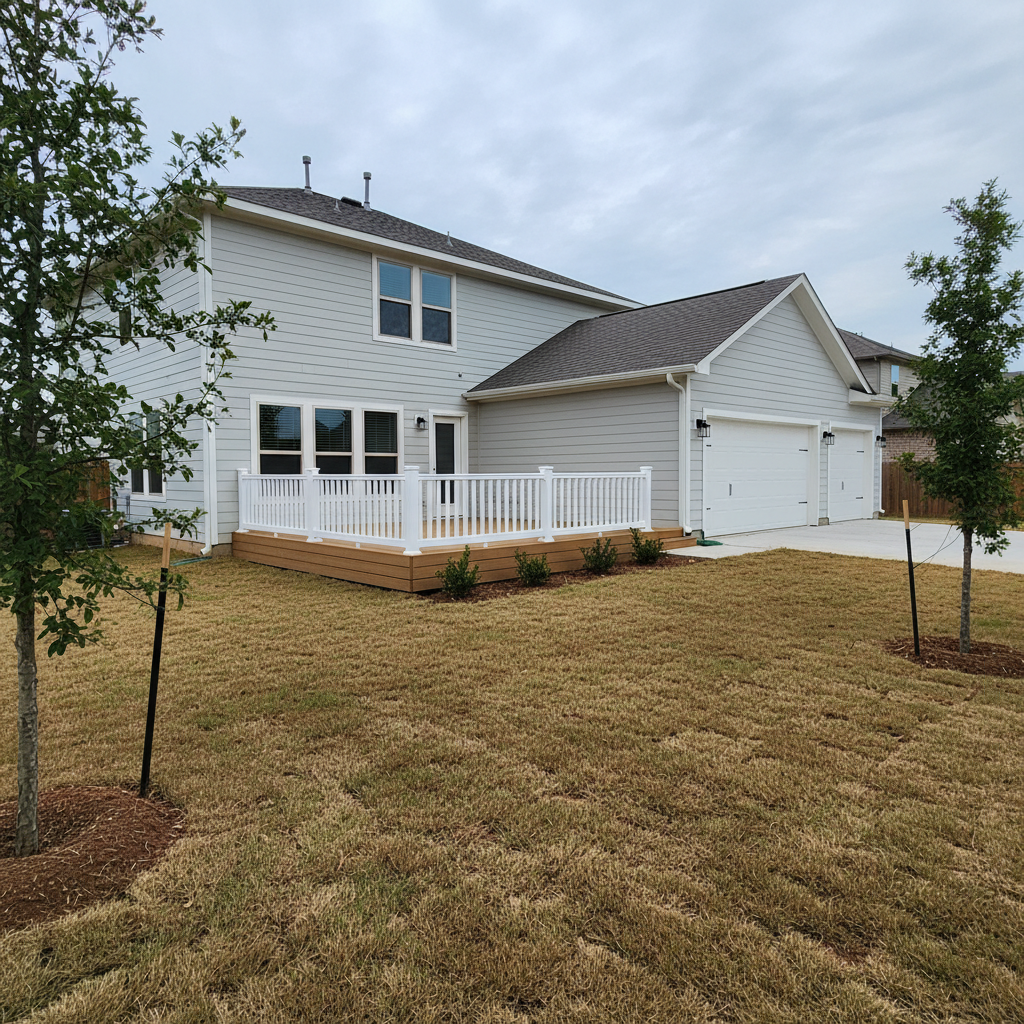
Garland sits on Blackland Prairie clay, and that one fact changes more about deck building here than most homeowners realize. This soil swells when it's wet and shrinks hard when it dries out in August. A deck footing poured without enough depth, or poured in a hurry on top of loose fill dirt, can heave or settle within a couple of years. If a builder doesn't bring up soil conditions before they bring up decking boards, that's worth noticing.
What the ground does to a deck
A proper footing here usually goes down 24 to 30 inches, below where the clay does most of its moving, and it needs to bell out at the bottom so the concrete isn't just sitting on a narrow column. Some builders use helical piers instead, which screw into the ground and skip the wait for concrete to cure. Either way, ask how deep the footings go and why. "We always do what the last guy did" is not an answer. Older neighborhoods near Downtown Garland and around Oak Shores often have decks from the 80s and 90s sitting on footings that were never deep enough to begin with, which is why so many repair calls in this city are really footing problems wearing a deck's clothes.
Freeze, heat, and humidity
North Texas doesn't get the deep frost of Minnesota, but it gets ice storms most winters, usually in January, and a hard freeze-thaw cycle still stresses concrete and fasteners. Summers run past 100 degrees for weeks at a stretch in July and August, which matters for staining and sealing. Stain applied in direct afternoon heat dries on the surface before it soaks in, and it peels within a season. A builder who schedules staining for early morning or picks a cooler stretch of the calendar is thinking about the finished product, not just getting off your property faster.
Permits, inspections, and why skipping them costs you later
The City of Garland requires a permit for most deck construction, and inspectors typically check the footing excavation before concrete goes in, then check the framing before the decking boards cover it up. Skip the permit and you skip both of those checks, which means nobody but your builder ever looks at the part of the deck you can't see once it's built. If you ever sell the house, an unpermitted deck can hold up closing or force you to pull a permit retroactively, which is a much worse conversation to have with the city after the fact. Ask straight out: will you pull the permit, and whose name is it under? A contractor who shrugs this off, or tells you permits are "usually not needed" for a deck attached to the house, is wrong or is cutting a corner on purpose.
If your property backs up to a greenbelt or sits in a subdivision with an HOA, which is common in the newer sections toward Firewheel and along the Rowlett border, check your HOA's rules before design even starts. Some restrict deck height, railing style, or how close you can build to a fence line. A good builder will ask if there's an HOA before drawing anything. A less careful one will find out after you've already got a complaint letter.
Materials: pressure-treated, composite, and what actually survives here
Pressure-treated southern yellow pine is still the standard for framing, and it's a fine choice for the structure underneath a deck even if the surface boards are something else. For the decking itself, you're mostly choosing between pressure-treated boards, which need staining every two to three years in this climate because the sun and humidity both go after the wood, and composite, which costs more up front but doesn't need that maintenance. Composite can get hot enough to be uncomfortable barefoot on a July afternoon, so if you've got young kids or a dog, that's worth asking the builder about before you commit to a dark color.
Fasteners matter more than people expect. Hidden fastener systems look cleaner, but they need to be rated for the board profile you're using, not just screwed in wherever they fit. And any ledger board, the piece that bolts your deck to the house, needs proper flashing behind it. Without flashing, water works its way behind the ledger and rots the rim joist of your house, not just the deck. This is one of the most common failure points on older decks in Garland, and it's invisible until the deck starts pulling away from the house.
Red flags worth walking away from
- No general liability insurance, or they can't produce proof of it on request. If a worker falls off a ladder on your property, you want that covered by their policy, not your homeowner's insurance.
- A bid that's dramatically lower than everyone else's. Decking lumber, composite material, and concrete all cost roughly the same no matter who's buying them. A lowball price usually means thinner footings, undersized joists spaced wider than 16 inches on center, or a plan to skip the permit altogether.
- Reluctance to put the scope of work in writing. A real contract names the materials, the joist spacing, the railing height (36 inches minimum for most residential decks, with baluster gaps under 4 inches so a small child can't slip through), and a rough timeline.
- No local references or completed work you can actually drive by and look at.
- Pressure to sign same-day. A deck is a multi-thousand-dollar structure attached to your house. Nobody good needs you to decide before dinner.
What a good process actually looks like
A builder who knows what they're doing walks your yard before quoting anything. They'll check the slope of the lot, since a lot of Garland yards grade toward the house more than they should after decades of soil settling, and water management around the footings affects how long those footings last. They'll ask about sun exposure, because a west-facing deck with no cover bakes all afternoon from May through September, which changes what material and what shade structure actually makes sense. They'll tell you how many days the footings need to cure before framing starts, generally a minimum of a few days even in summer heat, and they won't rush that step to hit a deadline.
Get at least two quotes, read them side by side, and ask each builder to walk you through the difference if the numbers aren't close. If you're weighing a full replacement against a repair, ask directly whether the existing footings and framing are sound enough to build on, or whether you're better off starting from the ground up. A contractor who's honest about that, even when the honest answer costs them a bigger job, is the one you want holding the permit. That's the kind of work we do at Midway Deck Company, built for the clay under your yard and the heat that comes every summer, not just whatever's fastest to frame up.